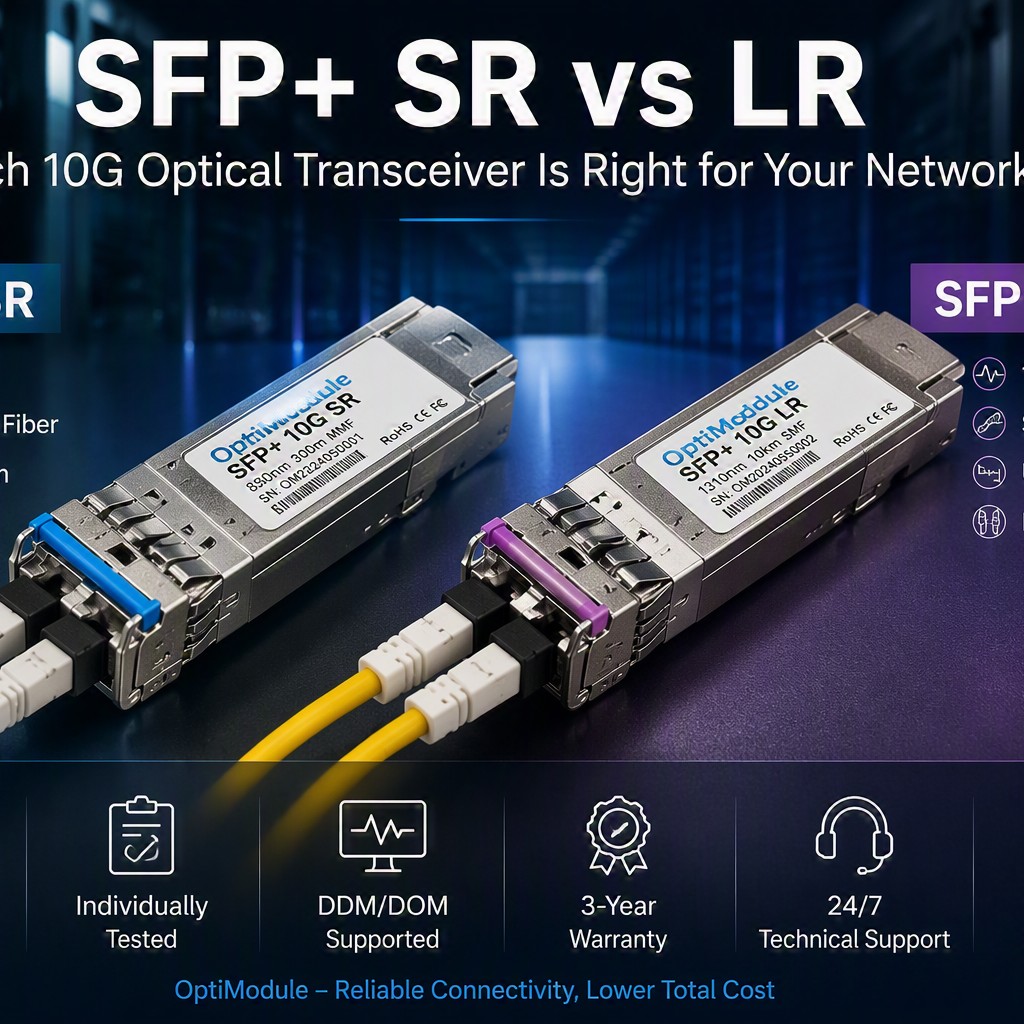
SFP+ SR vs LR: Which 10G Optical Transceiver Is Right for Your Network?
Introduction
As 10G Ethernet remains a cornerstone of modern enterprise and data center infrastructure, selecting the right optical transceiver is critical for achieving reliable performance and cost-effective deployment.
Among the most widely used 10G optical modules are SFP+ SR and SFP+ LR. Although both support 10 Gigabit Ethernet transmission, they are designed for different network environments and fiber infrastructures.
Understanding the differences between these two transceivers can help network administrators optimize performance while controlling deployment costs.
What Is SFP+ SR?
SFP+ SR (Short Reach) is a 10G optical transceiver designed for short-distance communication over multimode fiber (MMF).
Key Specifications
| Parameter | SFP+ SR |
|---|---|
| Data Rate | 10Gbps |
| Wavelength | 850nm |
| Fiber Type | Multimode Fiber (MMF) |
| Maximum Distance | Up to 300m |
| Connector | Duplex LC |
| Standard | 10GBASE-SR |
Advantages
- Lower module cost
- Cost-effective cabling for short distances
- Low power consumption
- Ideal for high-density data center deployments
Common Applications
- Server-to-switch connectivity
- Top-of-Rack (ToR) networking
- Data center aggregation
- Enterprise access networks
What Is SFP+ LR?
SFP+ LR (Long Reach) is designed for long-distance transmission over single-mode fiber (SMF).
Key Specifications
| Parameter | SFP+ LR |
|---|---|
| Data Rate | 10Gbps |
| Wavelength | 1310nm |
| Fiber Type | Single-Mode Fiber (SMF) |
| Maximum Distance | Up to 10km |
| Connector | Duplex LC |
| Standard | 10GBASE-LR |
Advantages
- Supports significantly longer transmission distances
- Suitable for campus and metropolitan networks
- Excellent future scalability
- Works with existing single-mode infrastructure
Common Applications
- Building-to-building connections
- Campus backbone networks
- Enterprise WAN deployments
- Metropolitan Ethernet networks
SFP+ SR vs LR: Side-by-Side Comparison
| Feature | SFP+ SR | SFP+ LR |
|---|---|---|
| Speed | 10Gbps | 10Gbps |
| Wavelength | 850nm | 1310nm |
| Fiber Type | Multimode Fiber | Single-Mode Fiber |
| Maximum Reach | 300m | 10km |
| Connector | Duplex LC | Duplex LC |
| Cabling Cost | Lower | Higher |
| Module Cost | Lower | Higher |
| Typical Deployment | Data Center | Enterprise & Campus |
Distance Requirements: The Most Important Factor
When choosing between SR and LR modules, transmission distance is usually the deciding factor.
Choose SFP+ SR When:
- The fiber run is under 300 meters
- Multimode fiber is already deployed
- The connection remains within a building
- Cost optimization is a priority
Choose SFP+ LR When:
- Distance exceeds 300 meters
- Single-mode fiber infrastructure exists
- Connecting multiple buildings
- Long-term scalability is important
Cost Considerations
Many organizations initially focus on the purchase price of the transceiver itself. However, the overall project cost should also include cabling infrastructure, installation requirements, and future expansion plans.
For short-distance deployments, SFP+ SR typically offers the lowest total deployment cost.
For longer-distance applications, SFP+ LR eliminates the limitations of multimode fiber and provides greater flexibility for future growth.
Organizations can often achieve substantial savings by selecting high-quality compatible optical transceivers instead of OEM-branded modules while maintaining reliable network performance.
Compatible Optical Transceivers from OptiModule
OptiModule offers enterprise-grade compatible optical transceivers designed for seamless interoperability with major networking platforms, including:
- Cisco
- Juniper
- Arista
- Dell
- Huawei
- HPE
- H3C
Recommended Products
- SFP+ 10G SR
- SFP+ 10G LR
All OptiModule transceivers are:
- 100% MSA Compliant
- Fully Compatibility Tested
- DDM/DOM Supported
- Backed by a 3-Year Warranty
- Supported by a 24-Hour Quote Response Team
Frequently Asked Questions
Can I use SFP+ SR and LR in the same network?
Yes. Many enterprise and campus networks use both module types depending on specific connection distances and fiber infrastructure.
Is SFP+ LR faster than SFP+ SR?
No. Both transceivers support the same 10Gbps data rate. The primary difference is transmission distance and fiber type.
Does SFP+ LR require single-mode fiber?
Yes. SFP+ LR is designed specifically for single-mode fiber and is not intended for multimode deployments.
Which transceiver is better for data centers?
For most short-distance data center connections, SFP+ SR is generally the preferred option due to lower deployment costs.
Conclusion
Both SFP+ SR and SFP+ LR are reliable 10G optical transceivers, but they are designed for different networking requirements.
Choose SFP+ SR when deploying short-range links over multimode fiber in data centers and enterprise environments.
Choose SFP+ LR when long-distance connectivity over single-mode fiber is required.
By selecting the right transceiver for your infrastructure, organizations can maximize performance, reduce deployment costs, and build networks that scale efficiently for future growth.