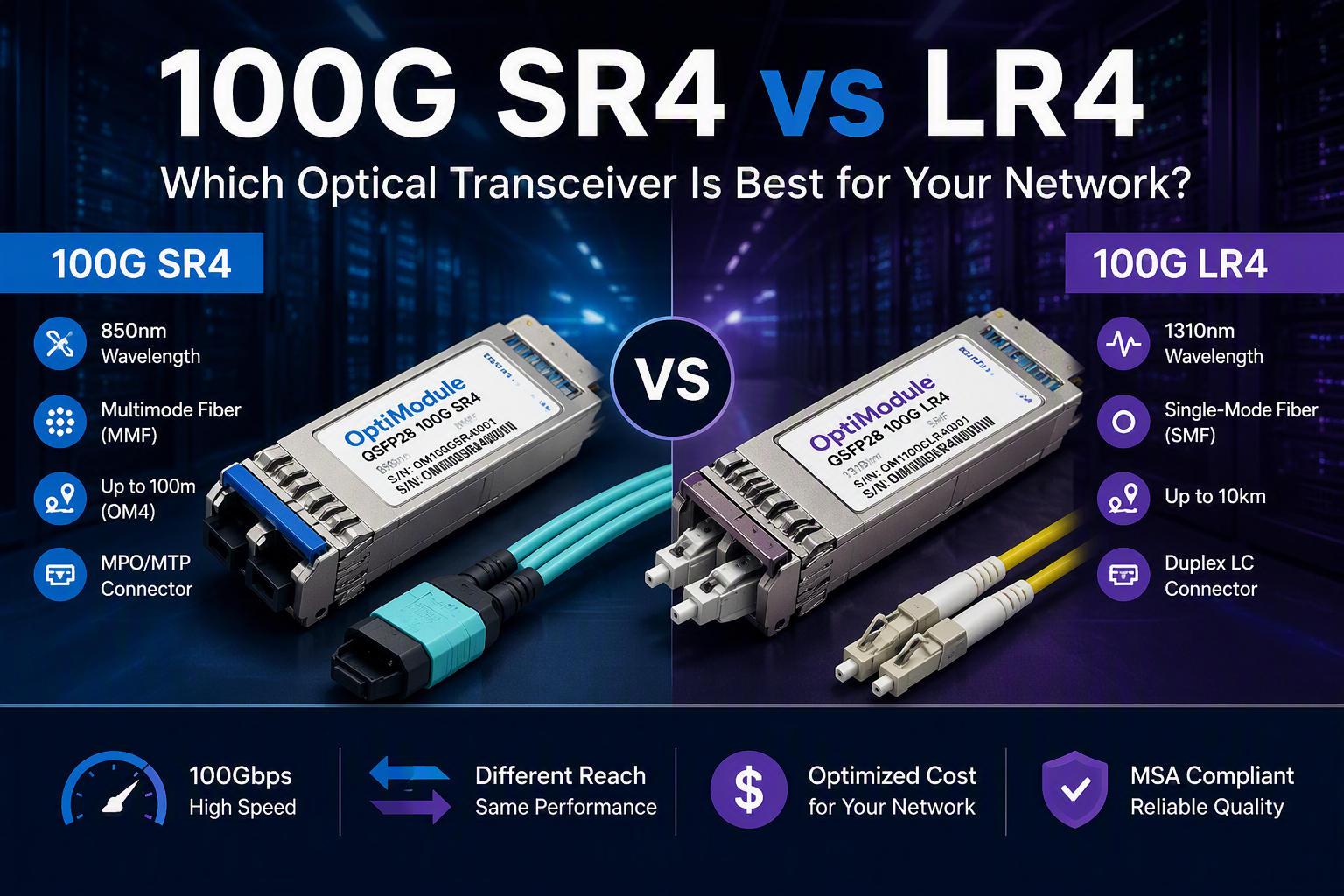
100G SR4 vs LR4: Which Optical Transceiver Is Best for Your Network?
Introduction
As 100G Ethernet becomes the standard for modern data centers and enterprise backbone networks, selecting the right optical transceiver is critical for balancing performance, scalability, and cost.
Among the most widely deployed 100G optical modules are the QSFP28 SR4 and QSFP28 LR4 transceivers. While both support 100Gbps transmission speeds, they are designed for very different networking environments.
This guide explains the differences between 100G SR4 and LR4 modules and helps network architects determine which solution best fits their infrastructure.
What Is QSFP28 SR4?
QSFP28 SR4 is a short-range 100G optical transceiver designed for use with multimode fiber (MMF).
Key characteristics include:
- 100Gbps Ethernet connectivity
- 850nm wavelength
- MPO/MTP connector
- Supports OM3 and OM4 multimode fiber
- Typical distance:
- 70m on OM3
- 100m on OM4
SR4 modules are commonly deployed within data centers where switches and servers are located in the same room or adjacent rows.
What Is QSFP28 LR4?
QSFP28 LR4 is a long-range 100G optical transceiver designed for single-mode fiber (SMF).
Key characteristics include:
- 100Gbps Ethernet connectivity
- CWDM transmission technology
- Duplex LC connector
- Single-mode fiber support
- Up to 10km transmission distance
LR4 modules are often used for campus networks, metro connections, and building-to-building links.
Technical Comparison
| Feature | QSFP28 SR4 | QSFP28 LR4 |
|---|---|---|
| Data Rate | 100Gbps | 100Gbps |
| Fiber Type | Multimode Fiber | Single-Mode Fiber |
| Connector | MPO/MTP | Duplex LC |
| Wavelength | 850nm | CWDM 1310nm |
| Maximum Distance | 100m | 10km |
| Typical Power Consumption | Lower | Higher |
| Deployment Cost | Lower | Higher |
Transmission Distance
Distance is often the primary factor when choosing between SR4 and LR4.
Choose SR4 when:
- Server-to-switch connectivity
- Top-of-Rack architecture
- Intra-data-center links
- Distances below 100 meters
Choose LR4 when:
- Building-to-building links
- Campus backbone networks
- Metro Ethernet connections
- Long fiber runs exceeding 100 meters
If future network expansion may require longer distances, LR4 provides additional flexibility.
Fiber Infrastructure Requirements
Fiber infrastructure significantly affects total deployment cost.
SR4 Infrastructure
SR4 requires:
Organizations that already operate multimode cabling systems often find SR4 to be the most economical solution.
LR4 Infrastructure
LR4 requires:
While optical modules are generally more expensive, single-mode fiber offers greater long-term scalability.
Cost Considerations
When evaluating project budgets, organizations should consider the total system cost rather than only transceiver pricing.
SR4 solutions typically have:
- Lower module costs
- Lower power consumption
- Cost-effective short-distance deployment
LR4 solutions generally provide:
- Greater transmission range
- Reduced network redesign requirements
- Better support for future expansion
Deployment Experience
Based on our experience supporting data center and enterprise deployments, many organizations initially assume they require long-range optics when their actual fiber runs are well below 100 meters.
In high-density data center environments, QSFP28 SR4 modules frequently provide the most cost-effective solution because they deliver full 100G performance without the additional expense associated with long-haul optics.
For campus backbone projects and inter-building connectivity, however, routing paths can easily exceed several hundred meters. In these situations, deploying LR4 modules from the beginning often reduces future upgrade costs and avoids infrastructure redesign.
Reliability and Scalability
Both SR4 and LR4 modules provide excellent reliability when installed within specification.
However, LR4 deployments generally offer greater flexibility because single-mode fiber remains compatible with higher-speed migration paths, including:
- 200G Ethernet
- 400G Ethernet
- Future AI and cloud networking architectures
Organizations planning long-term infrastructure growth may consider single-mode strategies as part of broader network modernization initiatives.
OptiModule Recommendation
When selecting between QSFP28 SR4 and LR4 transceivers, network designers should evaluate four key factors:
- Actual transmission distance
- Existing fiber infrastructure
- Project budget
- Future network expansion plans
For most data center applications below 100 meters, SR4 provides excellent performance and cost efficiency.
For campus, metro, and long-distance enterprise networks, LR4 offers greater reach and long-term scalability.
OptiModule provides a complete portfolio of MSA-compliant QSFP28 SR4 and LR4 transceivers designed for Cisco, Arista, Juniper, HPE, Dell, and other major networking platforms.
Conclusion
QSFP28 SR4 and LR4 transceivers serve different networking requirements despite sharing the same 100G transmission speed.
If your deployment focuses on short-reach data center connectivity, SR4 is often the most economical choice.
If your infrastructure requires extended distance, campus connectivity, or future-proof scalability, LR4 may provide better long-term value.
Understanding transmission distance, fiber type, and growth requirements ensures that your 100G network remains both reliable and cost effective for years to come.